Saturday, September 8, 2012

The Green's Tsunami Zone

Between scout camp and girls camp and cheerleading camp and volleyball camp, the Stake Pioneer Trek and EFY, the backpacking trip, and quick trips to Arizona (to see Poppy & family) and Provo (to drop Braiden off at BYU), we've been so busy this summer that I haven't had time to post family pictures.  This sign we saw when camping on Memorial Day weekend kind of sums up how it's felt:


Of course there were a few trips to the beach, but not enough!
 
Cousins came to visit
 
Jamie and the girls went to Solvang and talked Patty into going with them
 
Katie (on the left) at girls camp

Pioneer Trek - Taylor (in the middle)

Why is the Bishop the only one who looks happy?  (Maybe because he's not pulling?)

 Pioneer Braiden

Surfer girl Kate (with no braces!)


When we took Braiden to BYU we HAD to have lunch at the Red Iguana!

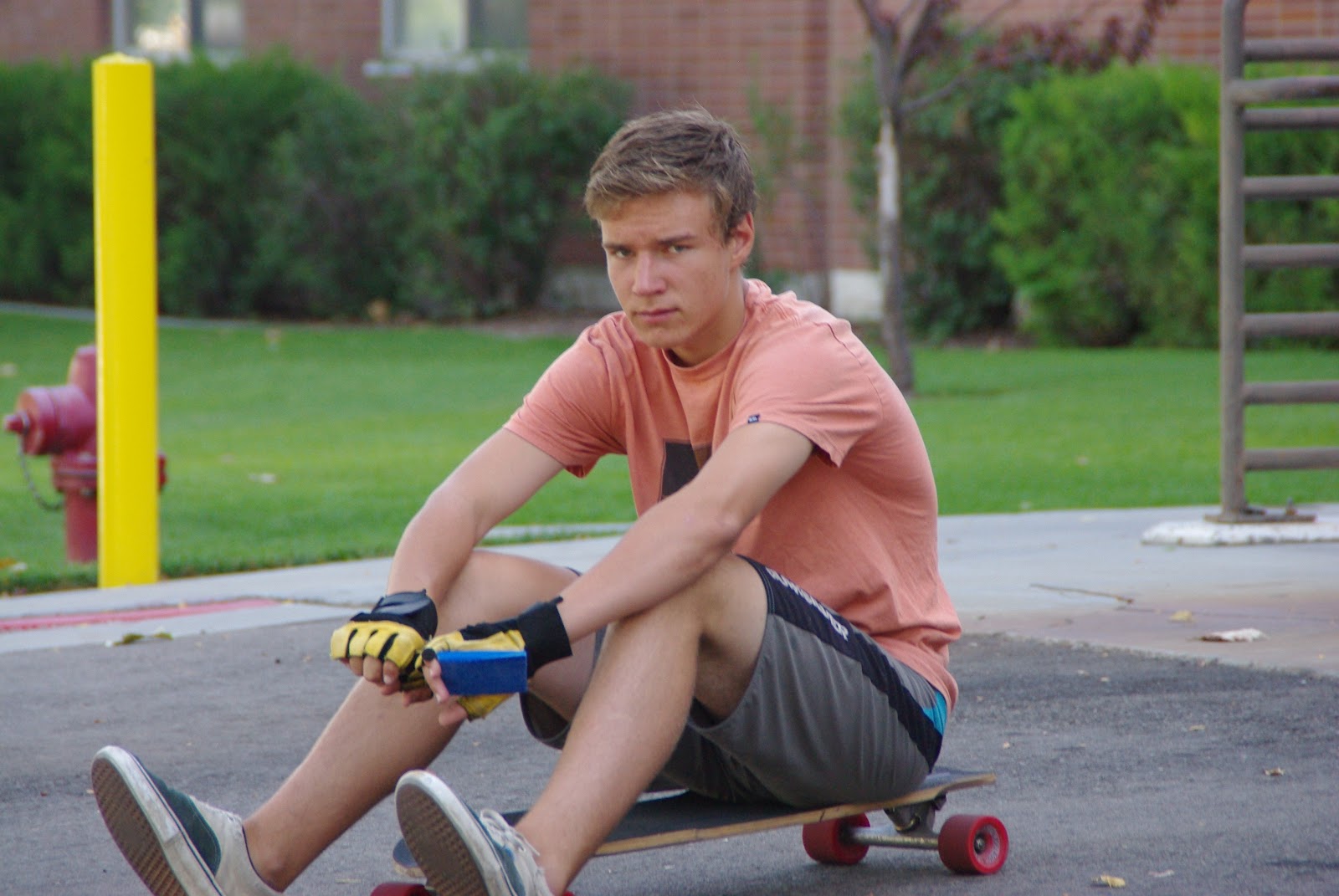
Poor Taylor!  BYU doesn't allow skateboarding on campus.


Saturday, September 1, 2012

"I have my bicycle."

"Everyone in their life has his own particular way of expressing life's purpose – the lawyer his eloquence, the painter his palette, and the man of letters his pen from which the quick words of his story flow. I have my bicycle." — Gino Bartali

It might be difficult to imagine a time before cars and airplanes made travel quick and easy, but in the earlier part of the century the bicycle was about the best many could hope for. It not only enabled them to go from place to place quickly but sometimes became necessary if you wanted a job. And with the rise of bicycles in Europe came cycling clubs and eventually races. One dominant Italian racer in the 1930s was Gino Bartali, whose incredible endurance on mountain slopes made him a formidable opponent and led to a 1938 victory in the Tour de France. But his racing career sputtered to an halt when war came, and he was put to use delivering messages on his bicycle... and later secretly transporting forged documents for Jewish families hiding from the police. That continued "training" helped when he later won the Tour de France again in 1948 at a time when he was thought "too old" (at 34!) and when his country was rocked by an assassination attempt and riots, and Bartali continues to hold the record for the most years between Tour victories.

Fans of Laura Hillenbrand's Unbroken will enjoy a similar story of heroism in the face of great danger and great odds in Road to Valor: A True Story of WWII Italy, the Nazis, and the Cyclist Who Inspired a Nation by Aili and Andres McConnon. From the early history of European cycling and the tragedies Bartali faced, to his quiet anti-fascism and secret work with Cardinal Elia Dalla Costa to protect Jews, to his racing struggles in the Alps, this is an inspiring story of courage in the face of real and personal danger.

I am not a cycling fan and had never heard of Bartali before, but I found the story to be well-written and a compelling read. I wish there had been a little more detail about the Tour itself (for those of us who know so little about it) but the rest of the story more than makes up for any missing information. Photographs of Bartali and elevation maps of the courses help as well, but the real highlight for me was the wartime experiences and how he risked his life for Jews. But the authors also bring the world of cycling alive, and the human element is combined excellently with the sports world here. A very inspiring read.  (I received this book from Amazon Vine.)

Tuesday, August 28, 2012

Mormon Moment or Mormon Myth?

I know that in some ways I'm naive. Most locker room humor goes over my head, I'm still not sure I really know what marijuana smells like, and the first time a nurse at the Red Cross blood drive asked to see my arms I had to ask why. But I'm fine with that; I don't think I'm missing anything by not being knowledgeable about such subjects. Yet being raised Mormon in Utah and mostly hearing only the more inspirational stories doesn't always prepare you for hearing the less inspiring parts of our history. It can lead some to question and even abandon their beliefs. But for me there was a moment when I was 19 years old and sitting in the Missionary Training Center (MTC) prior to leaving to serve a two-year mission in Brazil. I suddenly realized the commitment I was making and what I was giving up and leaving behind... and I had to know for myself that it wasn't a waste of my time. It wasn't enough to serve a mission just because my friends were doing it or because others expected me to go – I needed my own testimony (conviction) that I believed the things I would be teaching.

(Another example of how naive I can be: when I was offered another book on basically the same topic as this one I eventually accepted it because I found the similarity to this one interesting.  I looked at the early reviews on Amazon and they were mostly positive and many said it was "fair" and "unbiased."  My own opinion was very different.  Hopefully, I've learned my lesson.)

A lot of people are looking at Mormons right now, and I guess we must present an odd picture sometimes. Matthew Bowman has tried to write an academic look at the history of The Church of Jesus Christ of Latter-day Saints (the real name of the church) in his book The Mormon People: The Making of an American Faith. He covers the beginnings from Joseph Smith's background and his "First Vision," the early years and persecution, and the eventual exodus to Utah. He also looks at the growth of the church since then, from a small group of dedicated followers to a fast-growing worldwide membership, and he emphasizes the "American-ness" of the church and its values during that time. In his efforts to be scholarly and critical he deals with some sensitive issues – topics most Mormons are content to ignore – like polygamy and noisy dissidents throughout the years.

And it's his efforts to be critical that made me wonder about his personal beliefs. Except for a tiny dust-jacket blurb, you wouldn't know Mr. Bowman is a Mormon himself. He seems equally critical of Joseph Smith's lack of organizational leadership as he is of Brigham Young's mastery of it. I thought he was mocking the cherished pioneer legacy of the church when he called it a "romanticized theology of suffering." And he seems almost sympathetic to dissidents and those who publicly challenge church leaders and their authority, a view that seems at odds with a membership that actually considers their leader as a prophet called by God. And while I felt some parts were inspiring and others condescending, it made me wonder what kind of testimony Mr. (or should I say "Brother") Bowman might offer in a testimony meeting?

But I'm probably being overly sensitive and judging him too harshly given that he's trying to address questions that would seem perfectly natural to those outside the church. I looked at several professional reviews (NYTimes, Slate, etc.) and while it was generally well-received, a couple criticized him for being too dry. One even complained Bowman was hiding his religion, and wished he'd not held it at such arms-length (and I might agree). But otherwise most reviews were positive, and I'd probably agree with that as well. But if you pick it up (and especially if you're a Mormon), understand that it's trying very hard to be impartial and academic in its approach which unfortunately makes it occasionally dry, but otherwise not a bad book.  And a LOT better than some alternatives!

Saturday, August 25, 2012

Bashing Joseph Smith

(I don't usually post the exact same review on Amazon and my blog, but in this case I've already wasted enough time on this book and am making an exception. If interested, my Amazon review can be found by clicking here, and if you want to vote that it's helpful – to offset the "No" votes I'm sure to get – I won't stop you.)

With two Mormon candidates for US president in this election (now only one) the Mormon Church has received an unusual amount of news coverage, much of it negative. The Mormon or LDS Church is one of the fastest growing religions with over 14 million members worldwide (about half in the United States) and there are influential and successful Mormons in American politics, business, sports, entertainment, and many other areas which makes Stephen Mansfield very nervous. He wonders how a church that was so persecuted in its early days could have become such a potent symbol of American values and ideals. And, more importantly, he wonders what it might mean if a Mormon were elected president.

The Church of Jesus Christ of Latter-day Saints (which has been known historically as the Mormon Church) has long made a point of saying that its truthfulness hinges on the story of Joseph Smith. As a 14 year old boy Smith claimed to have a vision where he saw God and Jesus Christ, and that through him the gospel of Jesus Christ was "restored." This also involved the translation of The Book of Mormon, which Mormons claim as holy scripture in addition to the Bible. It follows that if Joseph Smith was a fraud, the church would be as well. But if Joseph Smith was a true prophet, then the church he established is true. As evidence they offer The Book of Mormon, and missionaries invite people all over the world to read it and pray about it.

This oft-repeated claim does not go unnoticed by the perceptive Mansfield in his book The Mormonizing of America: How the Mormon Religion Became a Dominant Force in Politics, Entertainment, and Pop Culture, and he uses it as the backbone of his attack. While he can be complimentary toward current members, his "history" of Joseph Smith and The Book of Mormon is a rehash of every anti-Mormon accusation regardless of merit or source. He repeatedly uses words like "fraud" and "charlatan" when describing Smith, and dismisses The Book of Mormon as boring and unsupported by evidence. (He also conveniently glosses over the fact that Joseph Smith gave his life for his cause and died as a martyr.) Instead, he lamely asserts that the incredible success of the church is due simply to its sense of community, focus on family and education, and its organization.

I tried to give the author the benefit of the doubt and assume his intentions were noble, but sadly this is a very poorly-researched book that was rushed to print before the election is over and the issue fades away. Like other anti-Mormon literature, Mansfield uses second-hand quotes and takes quotes out of context to make Mormon leaders seem extra strange, and anything factual is presented in a way to support his own bias. He uses lots of short vignettes that are supposedly real conversations happening every day in "Mormon America" that mostly play on irrational fears or cast Mormons in extreme ways. He continually gets his facts about the priesthood wrong and insinuates that polygamy is still practiced by church members. He even quotes a fictional novel to suggest Mormons claim to have planted all the sunflowers in the American west. And as a long-time member of the church I've never heard some of the "common Mormon sayings" he quotes.

I might agree with Mansfield when he says too many Mormons aren't familiar enough with doctrines (pg 56-57), but this ignores the fact that surveys show Mormons are generally more familiar with their own doctrines than non-Mormons are with theirs. He also says the church discourages its members from studying doctrine and favors "experience over doctrines" and emphasizes a "mystical inner knowing" instead, which mostly demonstrates his own lack of familiarity with his subject. He says The Book of Mormon has been "ignored as serious literature," but he's ignoring that it was recently named among the most influential books in America.

His explanation of how Mormons "became a dominant force" is weak (again, he says it's because of an emphasis on community, family, education, etc., and urges other churches to adopt such attitudes) and he questions the continuing loyalty and patriotism of members (even though he praises such attributes). He suggests a higher level of scrutiny is necessary and that the integrity of such previously honest people isn't good enough, which is really just a shameless political jab.

I do not resent or begrudge Mansfield for not sharing my religious beliefs – that's his prerogative – but there is little that is fair or unbiased in his book. He admits "Smith has come in for quite a bashing in these pages..." (pg 210), and laughably makes pretense at scholarly writing (pg xxii) even though the notes and sources at the end of the book occupy only a few short pages. (While I was reading it someone saw the unusually large font the book is printed with and asked if I was reading a children's book.) To use Mansfield's words, this book "need not have been written." (I received this book from the publisher.)

Saturday, August 18, 2012

Talkin' about a revolution

I've always been more interested in growing flowers or ornamental plants than vegetables, but over the last few years that's changed. I like the idea of growing more of the food we eat and having more control over what chemicals are used on it but mostly it's just a new challenge. One thing I've noticed is that "heirloom" varieties are becoming increasingly popular. These are the kinds of plants our grandparents might have grown and saved seed from each year. While they might not be as easy or productive as some more modern hybrids, they offer the promise of better taste. At least that's the theory, but my results so far have been pretty poor and we ended up with some tomatoes that didn't taste very good. Still, I'm not ready to give up and I was really looking forward to The Seed Underground: A Growing Revolution to Save Food by Janisse Ray which I received from Amazon Vine.

Ms. Ray recites statistics (several times) of how many varieties have been lost in just the last 100 years – and the huge numbers are disconcerting. Seed companies have bred hybrids with shelf-life and increased output in mind (frequently ignoring how they actually taste), and because they're hybrids farmers and gardeners can't save seeds from one year to the next and have them grow true. Even more distressing, companies and most farmers have turned to genetically-modified (GM) crops that have genetic traits artificially inserted for resistance to pests or – most alarmingly – chemical herbicides. All of this results in a contaminated and much-reduced gene pool and Ray argues that we have lost control of our food supply – which risks imminent collapse – and we are in need of a revolution.

I was hoping for a book that would talk about available heirloom varieties and might offer tips on the different kinds and ways to grow them. However, as Ms. Ray writes in the Introduction, "This is not a textbook on seed saving. I am looking to inspire you with my own life." (pg. xv) Instead she talks about her Georgia farm and visits to other farmers to acquire old varieties. Some of these episodes are interesting and she offers a few bits of advice, like pollinating squash flowers or saving tomato seeds or growing sweet potatoes. This is when the book really shines. But, "You won't get many of those details from me here," she writes, "My goal is simply to plant a seed." (pg 151) Much of the book is a paranoid screed against "big ag" and "big chemical" companies and how evil they and our government and justice system are (and some of her stories are indeed troublesome). "Science is worrisome when it only serves the interests of mercenaries and their employees... infecting our food supply with greed." (pg. 12) And in spite of her claim in the Preface that "I do not feel hopeless" (pg. ix) she later says "Who needs hope? ...It's not hope or love that keep me going. It's fight." (pg. 193)

Ms. Ray describes herself as a "granola" (a "back-to-the-earth" hippie who grew up post-60s) and comes off as a Luddite when it comes to technology. We get an earful of her philosophy of not flying and avoiding fossil-fuels ("Plastic is bad stuff." [pg. 129]) and basically living apart from modern society. Her attitude is militant and she calls anyone saving seeds a "revolutionary" and seems to find purpose in fighting modernity. But even she admits by the end that not all technology or corporations are evil, although she's not always sure where to draw the line. She acknowledges that sometimes hybrids combine beneficial traits and are useful, and public and private companies can do “good” (see pg. 174). (Incidentally, this is why many gardeners choose hybrids over heirlooms – they often grow better and are more reliable even if the taste is sometimes inferior. And spending a few bucks on seed packets is more convenient than the effort to save your own, as even she admits.)

Still, I don't disagree with all her arguments (mostly just her extremism) and I can certainly relate to her desire to grow older varieties. I'll continue to look for heirloom vegetables that grow well for me and that the family likes to eat. It's just a shame that information isn't found in this book.

Sunday, August 12, 2012

Time...

Jamie's been saying it for months now but it just hit me the other day: our oldest is about to leave home!

Every time she'd mention it (always a little teary-eyed) I'd say, no, he's just going up to school and we'll still see him. But then I realized we'll probably only see him at Christmas or a long weekend here or there, and when he comes home next summer it'll be to leave on his mission and then he'll really be gone for two years. After that he'll go right back to school and if he sticks with his major it'll probably mean graduate school, too. So, I guess this really is it.

And it makes me feel depressed.

And I feel old, too.

And I'm reminded of a line from a song in "Fiddler on the Roof" where Tevya says "I don't remember growing older, when did they?"

But I guess this is what we raise our children to do: leave.  We just hope they don't go too far and that they come back often.


Good luck, Braiden.  We'll miss you.

Saturday, August 4, 2012

Enola Gay

You may already know it but August 6th is the anniversary of the atomic bomb.  Yeah I know, not something you planned on celebrating, right?  Me neither.  But it's a part of history that interests me and something we should at least remember.  I've already reviewed books about the scientists and the bomb itself and the people of Hiroshima, as well as a really good book about the last two years of the war. Here's one about the plane and crew who actually dropped the bomb - Enola Gay: The Bombing of Hiroshima by Gordon Thomas and Max Morgan Witts.

Enola Gay: The Bombing of HiroshimaIn 1944 Air Force pilot Colonel Paul Tibbetts was approached by General Leslie Groves about assembling a unit for a super secret mission with possibilities of ending the war. He was given no guarantees for his personal safety or that it would even happen - only that if it worked he would be a hero, and if not... well, he was on his own. He assembled his unit, which eventually became known as the 509th Composite, with men he knew and trusted. They set up training in Wendover, a forsaken desert spot on the Utah/Nevada border, a place Tibbetts deemed perfect because his men would hate it. While he knew some particulars about the Manhattan Project and the atomic bomb, none of his men were given much information - and they were told if they said anything they could face prison time. This book follows the progress of the project mostly from the point of view of those involved with Col. Tibbetts and the crew of the B-29 named Enola Gay. Mr. Thomas also includes some brief details of the men's lives after the war, information on a number of Japanese individuals in Hiroshima, and some background on FDR and Truman and their early involvement.

Mr. Thomas tries very hard to keep an objective view of the events which ended the war with Japan and avoids vilifying anyone. He presents the facts and recollections of those involved giving a good idea of what it was like at the time and some insights into the various personalities. It's an engrossing and easy read and the build up to the bombing is exciting and tense. It's interesting to read how dangerous just taking off from a tiny little coral island with such a large and heavy bomb was, and the process of arming it shortly before it was dropped (and the very brief second thoughts the crew member responsible for that had), and the unusual instructions the crew was given to go into a steep dive and put as much distance and speed as they could between them and the target. Dark goggles and bracing for a shockwave made them realize it was going to be big, but no one had any idea how big. Unfortunately, the book falters after that and the aftermath is treated only in the lightest manner and details are few, making it feel somewhat anti-climatic. Nonetheless, a good book I recommend for those interested.

Saturday, July 28, 2012

Three big rocks: Kearsarge, Forester, and WHITNEY

If I had suspicions two years ago that I was getting "too old" for backpacking, this year didn't help. Although I take comfort that even Mike and David C. said this year's trip was the most strenuous they've ever done.


We drove up to Onion Valley on Friday (7/13) and camped overnight. It's about 9,200' elevation, and we hoped it would help with the acclimation because our Saturday hike (7 miles) would take us over Kearsarge Pass (11,820'). And I did really well until we stopped for lunch and the elevation started to get to me. At one point I couldn’t go on and had to rest for about 45 minutes. David H. was really kind and waited with me – I doubt I'd have made it without him – and gave me some ibuprofen which really helped (along with a bunch of prayer!). I just had to put my head down and focus on the trail in front of my feet... and I made it. (The pass is the edge of Kings Canyon Nat'l Park.) Remember that song "Put One Foot in Front of the Other," from the annimated "Santa Claus is Coming to Town?" It was stuck in my head all day.


Harrison, Taylor, and Walker on the John Muir Trail.

We spent that night and the next (Sunday) camped by the 2nd Kearsarge Lake, which was beautiful! And it was helpful to have a day to rest and get more accustomed to the elevation. But day 3 (Monday) we hiked to Bubbs Creek (about 10,400' and another 7 miles). It was fantastically beautiful – the trees, the lakes, the waterfalls, the VIEWS! And it was generally downhill (followed by some rather strenuous uphill climbing to make up for that lost elevation!). Much of it was on part of the Pacific Crest Trail (PCT) that was renamed the John Muir Trail.


David H., me, Mike, and David C. resting next to Bubbs Creek.

But Tuesday was the real killer! Nearly 12 miles and we went over Forester Pass, the highest pass on the PCT at 13,200'. (It's also the dividing line between Kings Canyon and Sequoia Nat'l Parks.) I was having visions of Big Sam all over again, but I actually did pretty well. I really pushed myself hard (and beat everyone but David C. to the top) but I was so sick when I got there that I could hardly eat any lunch. And the trail on the Sequoia side was very steep with lots of switchbacks that hugged the mountainside all the way down. We finally camped near Tyndall Creek (10,900') and I kept thinking: Why did I want to do this?

Me, Braiden, and Taylor atop Forester Pass.

As my 45th birthday present on Wednesday we hiked nearly 9 miles and went over Bighorn Plateau but it wasn't too bad. Just more and more incredible scenery, and I saw two does with their fawns playing in a meadow. There are a lot of people on these trails, too, and we shared some food with three guys who were on day 30 of their backpacking trip! We camped near the Crabtree ranger station, and then moved up to Guitar Lake (11,500') on Thursday (less than 3 miles).


Friday we got up early and set off for Whitney. It's about 3.5 miles to the trail junction and you gain 2,000 feet elevation in the switchbacks. The boys (who were usually way ahead of me) found a boy scout who'd been left behind by his troop and Taylor carried his pack up to the trail junction and Braiden stayed with him until he could get there (I was really proud of my boys!). But it was along this ascent that I started having dizzy spells. My vision would start spinning in the center (like those old b&w spirals) and I couldn't see straight – but I was determined to make it. Once I got past the junction it kind of went away but then it's nearly 2 miles (and another 1,000') with steep drop-offs and parts of the trail crumbling. At 14,500' Mt. Whitney is the highest point in the contiguous United States, but it's a great feeling once you get there! And the VIEW!

Looking down on Hitchcock Lakes on the way up to the Whitney Trail.

On top of Mt. Whitney, back: David C., Mike, David H., and me
front: Braiden, Harrison, Walker, and Taylor

We summited Whitney with just day packs, leaving our gear at Guitar Lake. It made it easier, except we had to do almost the same hike again on Saturday – up to the trail junction and over the trail crest (13,600') with full packs. Honestly, that wasn't the worst part, though. Not even the 99 switchbacks on the east side were very bad (going down, anyway). No, the worst part was the rest where the trail just never seemed to end. But I couldn't stop – I was almost running – and sadly I was beyond appreciating some very pretty scenery. And by the time I finally found the boys waiting at the bottom of Whitney Portal, all I could do was sit down on the ground and enjoy the Diet Coke Braiden brought me!
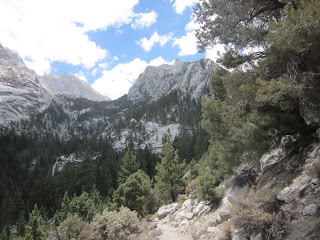

In all Mike figured we hiked about 60 miles (although his GPS said 65). Nights were a lot colder on this trip and I really appreciated the new sleeping bag. I avoided any blisters until the last day when I got one on my foot and one on my hand (from the walking stick). My pack started around 50-55 lbs and ended at 35. Although the dinners Mike made were fantastic, I could barely eat any lunch on the trail, so I'm sure I lost some weight but our scale doesn't work well (and I've probably eaten some of it back in the week since). But it was a good trip, and I'm glad I went. I won't make any promises for next year, but I'll go backpacking with Mike again. Hopefully the next time will be easier, though.

Friday, July 13, 2012

Uncommon vision

I haven't been very good about keeping up my blog lately. I've got several books I need to write reviews on before I forget them and I've been mostly coasting on posts I wrote months ago. I've also got half-written posts on what the family's been doing but haven't had time to pull the pictures from three different cameras (4 if I count my phone). The truth is I'm feeling burned out. Work is busy, the family's going in six different directions at once, and I've been focusing all my writing energies on my own book, the novel I hope to publish one day. The good news is that it's moving along better than ever and my goal is to finish the first draft this month. Then I'll take a few weeks off before starting on the rewrite, and Jamie suggested I write a short story in those weeks and post it here. We'll see how that goes...

... but first things first: backpacking. We leave today and expect to hike 50 to 60 miles over the next week carrying 40-50 lb packs and climb Mt. Whitney (the highest mountain in the lower 48 states) by the end. I've been alternately excited and dreading it for months now. (I'll report back afterward – hopefully!)

But with the trip in mind I picked up a book that had been on my TBR list for a couple years – A Passion for Nature: The Life of John Muir by Donald Worster. After donating blood last month I was reading it at the cookies and juice table (where I'm supposed to wait for 10 or 15 minutes, but unless someone starts talking to me I'm out in 4) when someone said "John Muir? Who's that?" Bear in mind that I live in California, and if you look at the back of the California quarter you'll see John Muir on it. Oh well...

John Muir was a leading naturalist in the late 1800s and early 1900s. He was the first president of the Sierra Club and prominent in establishing Yosemite National Park. He was probably more responsible than even Thoreau and Emerson for getting people to appreciate and conserve nature, although he didn't really set out to do that. He emigrated from Scotland when he was 10, studied botany at the university in Wisconsin, and had a knack for inventing machines. But after walking to the Gulf Coast from Wisconsin (soon after the Civil War) on his way to see the Amazon he ended up in San Francisco and took a job herding sheep in Yosemite Valley – and fell in love with the place. Before long he'd rambled over much of the Sierra Nevada Mountains and began writing newspaper articles on the places he'd seen. And even though he wasn't much of a writer it was through his articles and later books that he gained notoriety and eventually became the voice of American wilderness.

The interesting thing about Muir is that he wasn't an enemy of mankind or progress as some environmentalists seem today. He acknowledged that people need to survive on the land, but he wanted to protect those most amazing and spectacular sights that he saw as God's handiwork. To him, Nature wasn't "red, in tooth and claw," but beautiful from the tiniest wildflowers to the majestic work of glaciers over centuries. I'd previously read a book by Worster and was unimpressed by his somewhat Marxist views and disdain for American culture, but I appreciated the portrait he paints here of a man who wasn't rabid and unyielding in his beliefs but who sought to share a greater respect for Nature.

It's an interesting biography but not exceptionally so, but I wanted to understand more about him before I go hiking on the trail that was named in his honor.

Saturday, July 7, 2012

"Children, I wanna warn you..."

I gotta say, there are a lot of relatively obscure 80's new wave songs that were COMPLETELY AWESOME! When you take Adam Ant's band and add a 14 year old girl as lead singer who knows what you're going to get? Well, not a lot of hits unfortunately – but at least a couple of really good songs! (Plus a Scotland Yard investigation into "exploitation of a minor for immoral purposes" – but we all know the music industry would never stoop that low!)

Bow Wow Wow's most popular song was "I Want Candy," but "Do You Wanna Hold Me?" was my favorite. Apparently, the band was created to promote a line of clothing (???) and Boy George (who called himself "Lieutenant Lush" at the time) was initially considered as the lead singer – but they thought he was "too wild" so they went with some girl singing along with the radio in her family's dry cleaning shop!  (You think I'm making this stuff up?)  Like Adam Ant they used some African drumbeats, but does it also sound a little like the old 60's surf music to you too? (Maybe it's the guitar?)  Anyway, it's FUN music and I love it (even if the video is unusually strange!).