Tuesday, October 2, 2012

Not just for my teacher friends

I used to know a lot of smart people – until the election heated up, anyway. Now I get emails and see posts on Facebook about candidates with obviously questionable "facts." I'm not talking about the stuff that is clearly just meant to be funny. I'm talking about the stuff that makes outrageous claims and distorts what was actually said. It ought to be obvious that candidates will say things that fudge the truth (or worse) just because they're desperate to win. That doesn't mean we have to be fools about it! If something sounds too crazy to be true, it's probably not true. But forwarding it without checking first only annoys your friends and can cause them to unfriend you.

Phew! I just had to get that off my chest.

But speaking of how to know what is true, I recently read When Can You Trust the Experts: How to Tell Good Science from Bad in Education by Daniel T. Willingham. The book is specifically aimed at educators (teachers and administrators, but parents, too) who might be considering "educational software, games, workbooks or other programs" which claim to be "based on the latest research." While some of these products may be based on actual research, many are not. But how can you tell? Willingham discusses the history of science and the role it plays in persuading us and appealing to our biases (especially the "confirmation bias" where we look for "evidence" that supports what we already believe and discard what doesn't support it). Ultimately he outlines and explains four steps:
  • Strip it and Flip it. Strip the claim down to its essentials and promises: "If I do X, then there is a Y percent chance that Z will happen."
  • Trace it. Should you take statements by "authorities" at face value?
  • Analyze it. What evidence is offered? Is there any scientific evidence (from reliable studies) that support or refute the claims?
  • Should you do it? And how will you measure results, or when do you call it quits?
It's a rather straightforward process that can weed out a lot of programs and help you find (and understand) the kind of research for making better-informed decisions. And while it's geared more toward eduation professionals it's also written plainly enough that parents can use the same processes. I picked it up hoping it could apply to other areas where science is touted, like the breathless claims about climate change, for instance. Such issues are certainly beyond the scope of this book, but I think Willingham's method is a good place to start and can be applied in more areas than just education. But the main idea is to get people thinking for themselves and not be misled by emotional appeals or psuedo-science.

But when it comes to politics – GOOD LUCK! (I received this book from Amazon Vine.)

Saturday, September 22, 2012

An honest burglar

Happy Hobbit Day! Yes, in case you've forgotten, September 22nd is the birth date of both Bilbo and Frodo Baggins. And it's even more special this year because yesterday was the 75th anniversary of the publication of The Hobbit. So, join in the Hobbit Week celebrations as we all anxiously await the first movie (and it sounds like there's going to be 3 instead of just 2) scheduled to come out on December 14th. (I tried talking the family into going to a midnight premier but their response was as exciting as watching sea-monkeys come to life.)

Well, at any rate, The Hobbit was one of my favorite books growing up. I loved the charming way the story begins, the beautiful world it describes, and especially the humor. I even liked it better than The Lord of the Rings because it wasn't as dark and serious. As I've probably mentioned before, The Hobbit began as a story for Tolkien's own children, and when it was first published that's all there was about hobbits; The LOTR wasn't imagined yet and the ring was just a simple magic ring – it wasn't The Ring that it later became.

And that's the perspective Corey Olsen ("The Tolkien Professor") takes in his new book Exploring J.R.R. Tolkien's "The Hobbit". Olsen goes through The Hobbit chapter by chapter and points out the prevailing themes such as Bilbo's differing natures (Baggins vs. Took), how he grows through his choices, and how he actually becomes the burglar he was hired to be. He also discusses the role luck plays in the story and explains those songs the dwarves and elves sing that I always thought were so strange (now they make more sense). He doesn't bring in any peripheral information from Tolkien's life or his motivations for writing the story, but he does discuss the minor changes Tolkien made in preparation for the LOTR books.

In fact, did you know that Gollum originally waved a cheerful goodbye to Bilbo after showing him the way out of the caves back in the 1937 edition? I didn't. But when The Hobbit became a publishing success and fans were clamoring for more, Tolkien changed parts of the story slightly – like making Gollum more frightening and sinister – and blamed it on Bilbo trying to downplay the fact that he kinda stole the ring.

If you haven't already read The Hobbit, what's wrong with you? Oops, I mean, this would be an excellent book to read along with it, although there are a few minor "spoilers" where Olsen anticipates some events at the end of the story. But while a "book about a book" could sound kinda dull, I found it both fun to read and surprisingly interesting – like sitting in on the kind of discussions about the themes and ideas that I used to enjoy in high school and college English classes. (I guess I could always join a book club, but then I'd have to read what other people want to read and that just sounds like too much work.) I thought Olsen's conclusions and conjectures were very plausible, and his writing style easy to read.

Besides, what else are you going to do between now and December 14th?

(I was lucky enough to snag an advance copy of this book from Amazon Vine – they went pretty fast!)

Sunday, September 16, 2012

Running around naked

Back in March there was a news story from a technology conference in Austin, TX, about a company hiring homeless men to be wireless 4G hotspots. I guess the access was free but the company encouraged people to give a $2 donation to the homeless person. Of course, there was a lot of public outrage and the company was accused of exploitation. But in one of the news stories I heard they asked one of the homeless men what he thought about it, and his answer was interesting. He said something about how people didn't ignore him anymore or look away when they walked by. Instead people smiled and said hello, and many of them stopped and talked to him. He said he didn't feel "invisible" anymore.

In 1897 H. G. Wells published a short novel titled The Invisible Man. It tells the story of a stranger who arrives during a snowstorm at a small country inn in the English village of Iping in West Sussex. He is, of course, all bundled up with a coat, hat, and gloves, but his face is also fully bandaged and he wears dark goggles. He keeps to himself and stays in his room working with chemicals and laboratory equipment, only going out at night. But such a mysterious stranger in a small town naturally stirs up curiosity which leads to an incident where the man – who the reader obviously knows is invisible – is forced to flee unseen by taking off all his clothes.

He later tells his story to an old acquaintance from medical school. His name is Griffin and he is/was an albino, but he discovered a way to "lower the refractive index" of his body to the same as air so that he reflects no light, making himself invisible. He anticipated great advantages but not the troubles that would come with not being able to be seen.

Although I alluded to a social situation as an introduction, I'm stretching the comparison for this old “classic” science-fiction story – I just thought it was a nice intro (yes, I know there's another book with the same title that would have fit perfectly, but I didn't read that one). During the late Victorian (Romantic) period, the optimism of science was seen as also having a dark and dangerous side. Griffin imagines his work will "transcend magic" giving him power and freedom. His first impulse is "to jest, to startle people, to clap men on the back, fling people's hats astray," and yet he quickly realizes the true problems he faces. He has no money and no shelter (he had caused a fire that destroyed the room he rented), and wearing clothes (if he had any) would forfeit all advantages – yet it was January in London! He can't even eat because the undigested food remains visible and he can’t carry anything. The snow was settling on him and dirt and mud gathered on his feet making them visible. He can't speak to people, dogs could somehow sense him, and his attempts to steal clothing nearly get him caught – which would only make him a sideshow attraction.

I've seen comments by other reviewers alleging that Wells was channeling his socialist philosophies and that the story is a commentary on how capitalism had made the lower classes invisible, but I disagree. Griffin is never a very sympathetic character and although I tried to empathize with him and his unfortunate predicament, his unfriendliness and poorly contained anger make him a frightening protagonist. And there's plenty of evidence to question his sanity, although it's not clear if his madness is due to his experiment or just who he is. It seems more like a simple cautionary tale warning that just because we can do something doesn't mean we should. Although we can accomplish wonders in the name of science, we're still vulnerable to the dangerous human side of our selves.

And yet it's an interesting book to read. Who hasn't at some point or other wished they could be invisible? Just consider the downsides first – like having to run around naked in the winter!

Saturday, September 8, 2012

The Green's Tsunami Zone

Between scout camp and girls camp and cheerleading camp and volleyball camp, the Stake Pioneer Trek and EFY, the backpacking trip, and quick trips to Arizona (to see Poppy & family) and Provo (to drop Braiden off at BYU), we've been so busy this summer that I haven't had time to post family pictures.  This sign we saw when camping on Memorial Day weekend kind of sums up how it's felt:


Of course there were a few trips to the beach, but not enough!
 
Cousins came to visit
 
Jamie and the girls went to Solvang and talked Patty into going with them
 
Katie (on the left) at girls camp

Pioneer Trek - Taylor (in the middle)

Why is the Bishop the only one who looks happy?  (Maybe because he's not pulling?)

 Pioneer Braiden

Surfer girl Kate (with no braces!)


When we took Braiden to BYU we HAD to have lunch at the Red Iguana!

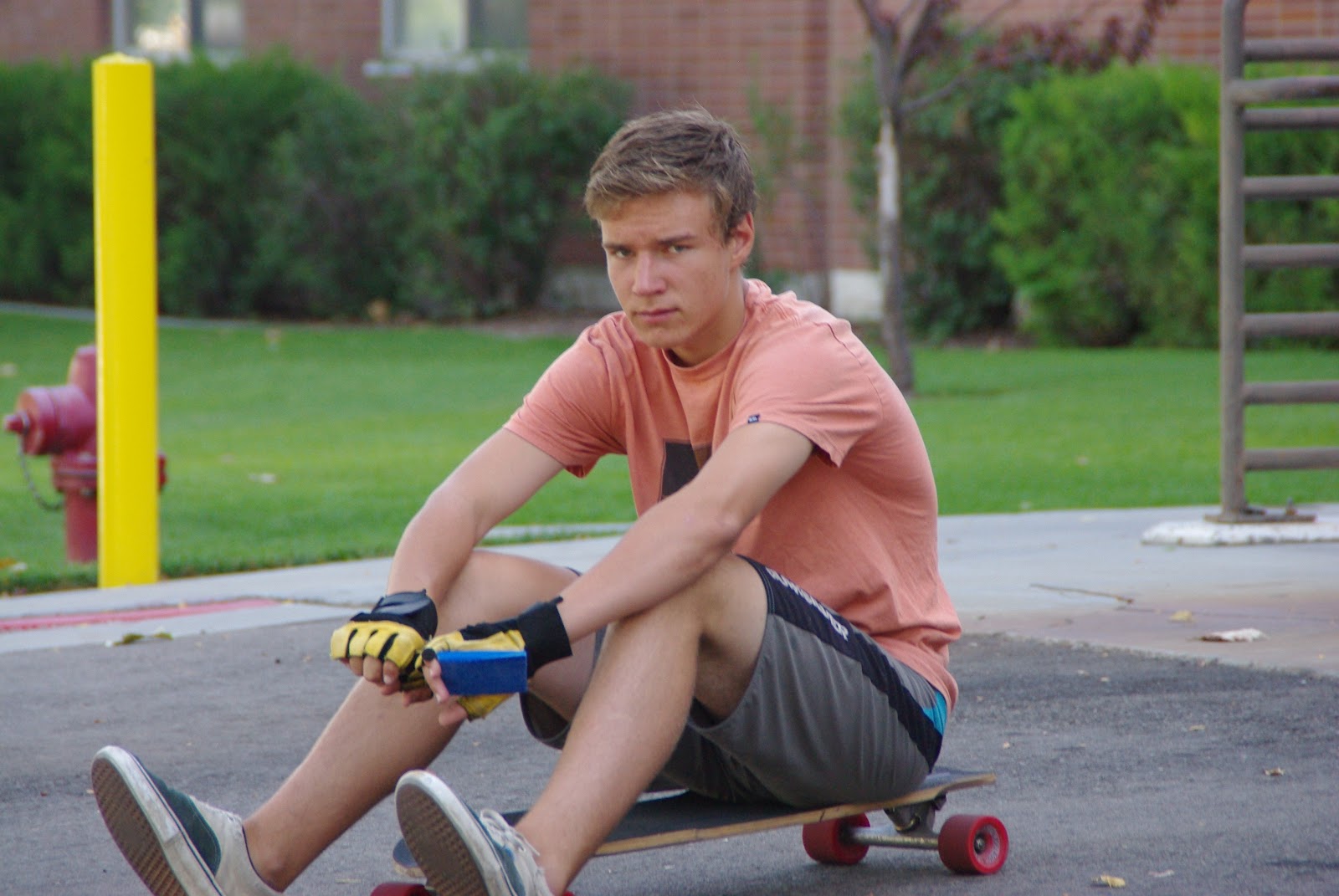
Poor Taylor!  BYU doesn't allow skateboarding on campus.


Saturday, September 1, 2012

"I have my bicycle."

"Everyone in their life has his own particular way of expressing life's purpose – the lawyer his eloquence, the painter his palette, and the man of letters his pen from which the quick words of his story flow. I have my bicycle." — Gino Bartali

It might be difficult to imagine a time before cars and airplanes made travel quick and easy, but in the earlier part of the century the bicycle was about the best many could hope for. It not only enabled them to go from place to place quickly but sometimes became necessary if you wanted a job. And with the rise of bicycles in Europe came cycling clubs and eventually races. One dominant Italian racer in the 1930s was Gino Bartali, whose incredible endurance on mountain slopes made him a formidable opponent and led to a 1938 victory in the Tour de France. But his racing career sputtered to an halt when war came, and he was put to use delivering messages on his bicycle... and later secretly transporting forged documents for Jewish families hiding from the police. That continued "training" helped when he later won the Tour de France again in 1948 at a time when he was thought "too old" (at 34!) and when his country was rocked by an assassination attempt and riots, and Bartali continues to hold the record for the most years between Tour victories.

Fans of Laura Hillenbrand's Unbroken will enjoy a similar story of heroism in the face of great danger and great odds in Road to Valor: A True Story of WWII Italy, the Nazis, and the Cyclist Who Inspired a Nation by Aili and Andres McConnon. From the early history of European cycling and the tragedies Bartali faced, to his quiet anti-fascism and secret work with Cardinal Elia Dalla Costa to protect Jews, to his racing struggles in the Alps, this is an inspiring story of courage in the face of real and personal danger.

I am not a cycling fan and had never heard of Bartali before, but I found the story to be well-written and a compelling read. I wish there had been a little more detail about the Tour itself (for those of us who know so little about it) but the rest of the story more than makes up for any missing information. Photographs of Bartali and elevation maps of the courses help as well, but the real highlight for me was the wartime experiences and how he risked his life for Jews. But the authors also bring the world of cycling alive, and the human element is combined excellently with the sports world here. A very inspiring read.  (I received this book from Amazon Vine.)

Tuesday, August 28, 2012

Mormon Moment or Mormon Myth?

I know that in some ways I'm naive. Most locker room humor goes over my head, I'm still not sure I really know what marijuana smells like, and the first time a nurse at the Red Cross blood drive asked to see my arms I had to ask why. But I'm fine with that; I don't think I'm missing anything by not being knowledgeable about such subjects. Yet being raised Mormon in Utah and mostly hearing only the more inspirational stories doesn't always prepare you for hearing the less inspiring parts of our history. It can lead some to question and even abandon their beliefs. But for me there was a moment when I was 19 years old and sitting in the Missionary Training Center (MTC) prior to leaving to serve a two-year mission in Brazil. I suddenly realized the commitment I was making and what I was giving up and leaving behind... and I had to know for myself that it wasn't a waste of my time. It wasn't enough to serve a mission just because my friends were doing it or because others expected me to go – I needed my own testimony (conviction) that I believed the things I would be teaching.

(Another example of how naive I can be: when I was offered another book on basically the same topic as this one I eventually accepted it because I found the similarity to this one interesting.  I looked at the early reviews on Amazon and they were mostly positive and many said it was "fair" and "unbiased."  My own opinion was very different.  Hopefully, I've learned my lesson.)

A lot of people are looking at Mormons right now, and I guess we must present an odd picture sometimes. Matthew Bowman has tried to write an academic look at the history of The Church of Jesus Christ of Latter-day Saints (the real name of the church) in his book The Mormon People: The Making of an American Faith. He covers the beginnings from Joseph Smith's background and his "First Vision," the early years and persecution, and the eventual exodus to Utah. He also looks at the growth of the church since then, from a small group of dedicated followers to a fast-growing worldwide membership, and he emphasizes the "American-ness" of the church and its values during that time. In his efforts to be scholarly and critical he deals with some sensitive issues – topics most Mormons are content to ignore – like polygamy and noisy dissidents throughout the years.

And it's his efforts to be critical that made me wonder about his personal beliefs. Except for a tiny dust-jacket blurb, you wouldn't know Mr. Bowman is a Mormon himself. He seems equally critical of Joseph Smith's lack of organizational leadership as he is of Brigham Young's mastery of it. I thought he was mocking the cherished pioneer legacy of the church when he called it a "romanticized theology of suffering." And he seems almost sympathetic to dissidents and those who publicly challenge church leaders and their authority, a view that seems at odds with a membership that actually considers their leader as a prophet called by God. And while I felt some parts were inspiring and others condescending, it made me wonder what kind of testimony Mr. (or should I say "Brother") Bowman might offer in a testimony meeting?

But I'm probably being overly sensitive and judging him too harshly given that he's trying to address questions that would seem perfectly natural to those outside the church. I looked at several professional reviews (NYTimes, Slate, etc.) and while it was generally well-received, a couple criticized him for being too dry. One even complained Bowman was hiding his religion, and wished he'd not held it at such arms-length (and I might agree). But otherwise most reviews were positive, and I'd probably agree with that as well. But if you pick it up (and especially if you're a Mormon), understand that it's trying very hard to be impartial and academic in its approach which unfortunately makes it occasionally dry, but otherwise not a bad book.  And a LOT better than some alternatives!

Saturday, August 25, 2012

Bashing Joseph Smith

(I don't usually post the exact same review on Amazon and my blog, but in this case I've already wasted enough time on this book and am making an exception. If interested, my Amazon review can be found by clicking here, and if you want to vote that it's helpful – to offset the "No" votes I'm sure to get – I won't stop you.)

With two Mormon candidates for US president in this election (now only one) the Mormon Church has received an unusual amount of news coverage, much of it negative. The Mormon or LDS Church is one of the fastest growing religions with over 14 million members worldwide (about half in the United States) and there are influential and successful Mormons in American politics, business, sports, entertainment, and many other areas which makes Stephen Mansfield very nervous. He wonders how a church that was so persecuted in its early days could have become such a potent symbol of American values and ideals. And, more importantly, he wonders what it might mean if a Mormon were elected president.

The Church of Jesus Christ of Latter-day Saints (which has been known historically as the Mormon Church) has long made a point of saying that its truthfulness hinges on the story of Joseph Smith. As a 14 year old boy Smith claimed to have a vision where he saw God and Jesus Christ, and that through him the gospel of Jesus Christ was "restored." This also involved the translation of The Book of Mormon, which Mormons claim as holy scripture in addition to the Bible. It follows that if Joseph Smith was a fraud, the church would be as well. But if Joseph Smith was a true prophet, then the church he established is true. As evidence they offer The Book of Mormon, and missionaries invite people all over the world to read it and pray about it.

This oft-repeated claim does not go unnoticed by the perceptive Mansfield in his book The Mormonizing of America: How the Mormon Religion Became a Dominant Force in Politics, Entertainment, and Pop Culture, and he uses it as the backbone of his attack. While he can be complimentary toward current members, his "history" of Joseph Smith and The Book of Mormon is a rehash of every anti-Mormon accusation regardless of merit or source. He repeatedly uses words like "fraud" and "charlatan" when describing Smith, and dismisses The Book of Mormon as boring and unsupported by evidence. (He also conveniently glosses over the fact that Joseph Smith gave his life for his cause and died as a martyr.) Instead, he lamely asserts that the incredible success of the church is due simply to its sense of community, focus on family and education, and its organization.

I tried to give the author the benefit of the doubt and assume his intentions were noble, but sadly this is a very poorly-researched book that was rushed to print before the election is over and the issue fades away. Like other anti-Mormon literature, Mansfield uses second-hand quotes and takes quotes out of context to make Mormon leaders seem extra strange, and anything factual is presented in a way to support his own bias. He uses lots of short vignettes that are supposedly real conversations happening every day in "Mormon America" that mostly play on irrational fears or cast Mormons in extreme ways. He continually gets his facts about the priesthood wrong and insinuates that polygamy is still practiced by church members. He even quotes a fictional novel to suggest Mormons claim to have planted all the sunflowers in the American west. And as a long-time member of the church I've never heard some of the "common Mormon sayings" he quotes.

I might agree with Mansfield when he says too many Mormons aren't familiar enough with doctrines (pg 56-57), but this ignores the fact that surveys show Mormons are generally more familiar with their own doctrines than non-Mormons are with theirs. He also says the church discourages its members from studying doctrine and favors "experience over doctrines" and emphasizes a "mystical inner knowing" instead, which mostly demonstrates his own lack of familiarity with his subject. He says The Book of Mormon has been "ignored as serious literature," but he's ignoring that it was recently named among the most influential books in America.

His explanation of how Mormons "became a dominant force" is weak (again, he says it's because of an emphasis on community, family, education, etc., and urges other churches to adopt such attitudes) and he questions the continuing loyalty and patriotism of members (even though he praises such attributes). He suggests a higher level of scrutiny is necessary and that the integrity of such previously honest people isn't good enough, which is really just a shameless political jab.

I do not resent or begrudge Mansfield for not sharing my religious beliefs – that's his prerogative – but there is little that is fair or unbiased in his book. He admits "Smith has come in for quite a bashing in these pages..." (pg 210), and laughably makes pretense at scholarly writing (pg xxii) even though the notes and sources at the end of the book occupy only a few short pages. (While I was reading it someone saw the unusually large font the book is printed with and asked if I was reading a children's book.) To use Mansfield's words, this book "need not have been written." (I received this book from the publisher.)

Saturday, August 18, 2012

Talkin' about a revolution

I've always been more interested in growing flowers or ornamental plants than vegetables, but over the last few years that's changed. I like the idea of growing more of the food we eat and having more control over what chemicals are used on it but mostly it's just a new challenge. One thing I've noticed is that "heirloom" varieties are becoming increasingly popular. These are the kinds of plants our grandparents might have grown and saved seed from each year. While they might not be as easy or productive as some more modern hybrids, they offer the promise of better taste. At least that's the theory, but my results so far have been pretty poor and we ended up with some tomatoes that didn't taste very good. Still, I'm not ready to give up and I was really looking forward to The Seed Underground: A Growing Revolution to Save Food by Janisse Ray which I received from Amazon Vine.

Ms. Ray recites statistics (several times) of how many varieties have been lost in just the last 100 years – and the huge numbers are disconcerting. Seed companies have bred hybrids with shelf-life and increased output in mind (frequently ignoring how they actually taste), and because they're hybrids farmers and gardeners can't save seeds from one year to the next and have them grow true. Even more distressing, companies and most farmers have turned to genetically-modified (GM) crops that have genetic traits artificially inserted for resistance to pests or – most alarmingly – chemical herbicides. All of this results in a contaminated and much-reduced gene pool and Ray argues that we have lost control of our food supply – which risks imminent collapse – and we are in need of a revolution.

I was hoping for a book that would talk about available heirloom varieties and might offer tips on the different kinds and ways to grow them. However, as Ms. Ray writes in the Introduction, "This is not a textbook on seed saving. I am looking to inspire you with my own life." (pg. xv) Instead she talks about her Georgia farm and visits to other farmers to acquire old varieties. Some of these episodes are interesting and she offers a few bits of advice, like pollinating squash flowers or saving tomato seeds or growing sweet potatoes. This is when the book really shines. But, "You won't get many of those details from me here," she writes, "My goal is simply to plant a seed." (pg 151) Much of the book is a paranoid screed against "big ag" and "big chemical" companies and how evil they and our government and justice system are (and some of her stories are indeed troublesome). "Science is worrisome when it only serves the interests of mercenaries and their employees... infecting our food supply with greed." (pg. 12) And in spite of her claim in the Preface that "I do not feel hopeless" (pg. ix) she later says "Who needs hope? ...It's not hope or love that keep me going. It's fight." (pg. 193)

Ms. Ray describes herself as a "granola" (a "back-to-the-earth" hippie who grew up post-60s) and comes off as a Luddite when it comes to technology. We get an earful of her philosophy of not flying and avoiding fossil-fuels ("Plastic is bad stuff." [pg. 129]) and basically living apart from modern society. Her attitude is militant and she calls anyone saving seeds a "revolutionary" and seems to find purpose in fighting modernity. But even she admits by the end that not all technology or corporations are evil, although she's not always sure where to draw the line. She acknowledges that sometimes hybrids combine beneficial traits and are useful, and public and private companies can do “good” (see pg. 174). (Incidentally, this is why many gardeners choose hybrids over heirlooms – they often grow better and are more reliable even if the taste is sometimes inferior. And spending a few bucks on seed packets is more convenient than the effort to save your own, as even she admits.)

Still, I don't disagree with all her arguments (mostly just her extremism) and I can certainly relate to her desire to grow older varieties. I'll continue to look for heirloom vegetables that grow well for me and that the family likes to eat. It's just a shame that information isn't found in this book.

Sunday, August 12, 2012

Time...

Jamie's been saying it for months now but it just hit me the other day: our oldest is about to leave home!

Every time she'd mention it (always a little teary-eyed) I'd say, no, he's just going up to school and we'll still see him. But then I realized we'll probably only see him at Christmas or a long weekend here or there, and when he comes home next summer it'll be to leave on his mission and then he'll really be gone for two years. After that he'll go right back to school and if he sticks with his major it'll probably mean graduate school, too. So, I guess this really is it.

And it makes me feel depressed.

And I feel old, too.

And I'm reminded of a line from a song in "Fiddler on the Roof" where Tevya says "I don't remember growing older, when did they?"

But I guess this is what we raise our children to do: leave.  We just hope they don't go too far and that they come back often.


Good luck, Braiden.  We'll miss you.

Saturday, August 4, 2012

Enola Gay

You may already know it but August 6th is the anniversary of the atomic bomb.  Yeah I know, not something you planned on celebrating, right?  Me neither.  But it's a part of history that interests me and something we should at least remember.  I've already reviewed books about the scientists and the bomb itself and the people of Hiroshima, as well as a really good book about the last two years of the war. Here's one about the plane and crew who actually dropped the bomb - Enola Gay: The Bombing of Hiroshima by Gordon Thomas and Max Morgan Witts.

Enola Gay: The Bombing of HiroshimaIn 1944 Air Force pilot Colonel Paul Tibbetts was approached by General Leslie Groves about assembling a unit for a super secret mission with possibilities of ending the war. He was given no guarantees for his personal safety or that it would even happen - only that if it worked he would be a hero, and if not... well, he was on his own. He assembled his unit, which eventually became known as the 509th Composite, with men he knew and trusted. They set up training in Wendover, a forsaken desert spot on the Utah/Nevada border, a place Tibbetts deemed perfect because his men would hate it. While he knew some particulars about the Manhattan Project and the atomic bomb, none of his men were given much information - and they were told if they said anything they could face prison time. This book follows the progress of the project mostly from the point of view of those involved with Col. Tibbetts and the crew of the B-29 named Enola Gay. Mr. Thomas also includes some brief details of the men's lives after the war, information on a number of Japanese individuals in Hiroshima, and some background on FDR and Truman and their early involvement.

Mr. Thomas tries very hard to keep an objective view of the events which ended the war with Japan and avoids vilifying anyone. He presents the facts and recollections of those involved giving a good idea of what it was like at the time and some insights into the various personalities. It's an engrossing and easy read and the build up to the bombing is exciting and tense. It's interesting to read how dangerous just taking off from a tiny little coral island with such a large and heavy bomb was, and the process of arming it shortly before it was dropped (and the very brief second thoughts the crew member responsible for that had), and the unusual instructions the crew was given to go into a steep dive and put as much distance and speed as they could between them and the target. Dark goggles and bracing for a shockwave made them realize it was going to be big, but no one had any idea how big. Unfortunately, the book falters after that and the aftermath is treated only in the lightest manner and details are few, making it feel somewhat anti-climatic. Nonetheless, a good book I recommend for those interested.